Sunday, January 29, 2017

Jerome Gambit: Old McDonnell

Kevin Sheldrick ("Cliff Hardy") sends one of his latest Jerome Gambits. He gets into trouble, but he calls upon his creativity and his "Jerome pawns" save him. The comments are mostly Kevin's. I have added a few diagrams and some notes in blue - Rick


Old McDonnell Had a Pawn Storm

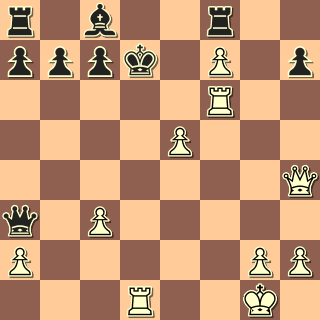
A kingside pawn storm features in many Jerome Gambit games, as is clearly evident in the games on this blog. In that vein, I recently played a Jerome Gambit game that reminded me somewhat of a famous position from an old game between two classic masters, Alexander McDonnell and Louis-Charles de La Bourdonnais in London in 1834. These were two of the strongest players in the world at the time and the final position in that game I have heard being referred to as, arguably, the most famous position in chess history.


La Bourdonnais, as black, has just played 37...e2, and so McDonnell resigned in a lost position, despite being the player who currently has a queen on the board.

My game: 

dsjkljdkdjkf - beba buba beba542
15 0, instantchess.com, 25/1/17

1.e4 e5 2.Nf3 Nc6 3.Bc4 Bc5 4.Bxf7+ Kxf7 5.Nxe5+ Kf8 6.Qh5??


6.Nxc6! would have been better. (See gfdgfd - leleos
InstantChess.com, 2016.)

6...Nxe5 7.Qxe5 d6 8.Qg3 Nf6 9.d3 h5 10.Bg5 Bd4?!


The odd-looking 10...Qd7!, blocking his bishop on c8 but breaking the pin on the knight on f6, was best. (10...Be6 was perrypawnpusher - ulisimbolon, Giuoco Piano Thematic, Chess.com, 2016 [0-1, 22])

11.c3 Be5??

11...Bb6 would still leave black with a clear advantage.

12.f4

Old McDonnell had a bishop!

12...h4 13. Bxh4??

13.Qf3! Bg4 14.Qe3 and white will win the trapped bishop on e5, with a winning position.

13...Nh5!

13...Nh5 was good for a slight advantage for black (saves his bishop on e5) but 13...Nxe4! was slightly better than that again

14.Qf2 Bf6 15.Bxf6 Qxf6 16.0-0 Bd7 17.Nd2 Ke7 18.d4 Raf8 19.f5 Kd8 20.Rae1 Qg5 21.Nf3 Qg4 22.h3 Qg3


23.Qxg3?

23.Re3 would yield an approximately equal position.

23...Nxg3 24.Rf2 Rhg8?

24...Re8, attacking the e-pawn, would lead to a winning advantage for black, whereas after 24...Rhg8?, white has a slight advantage.

25.Kh2 Nh5 26.g4 Nf4 27.Kg3??


E - I - E - I - O! I missed the fork.

27...Nd3 28.e5 Nxe1 29.Nxe1 de 30.de Bc6 31.g5 Kc8 32.Kg4 Rd8 33.h4 Rd1 34.Re2 Rgd8?


Black is still better but 34...Bb5! 35.Re3 Rd2, with a powerful rook on the seventh rank, would lead to a really crushing position for black.

35.e6

With a push-push here and a push-push there of my e- and f-pawns, I was hoping to pull off a swindle, though 35. h5! (i.e. everywhere a push-push!), with a four-pawn storm, would give me better chances to fluke a win from my bad position.

35...R8d2 36.Rxd2 Rxd2 37.f6 gf 38.gf Bd5 39.Kf5 Rf2+ 40.Ke5 Bxa2 41.f7 Re2+??

41...Kd8! was actually the only winning move for black here.

42.Kf4

Now white has a winning position!

42...Rf2+ 43.Nf3 Bxe6 44.f8=Q+ Kd7 45.Qg7+ Kd6 46.Qd4+ Bd5 47.Qxf2 c6 48.Qxa7 Bxf3 49.Kxf3 and black resigned.


Take care of your "Jerome pawns" and they will take care of you. Wonderful, Kevin!

Friday, January 27, 2017

Your Opponent is Overrated


For my birthday my wife gave me James Schuyler's Your Opponent is Overrated (Everyman Chess, 2016). I appreciate the subtitle: A Practical Guide to Inducing Errors.

I have not gotten into the book, but the text on the back cover is enticing
Which opening does better in practice: the wild, "unsound" and "refuted" Latvian Gambit (1.e4 e5 2.Nf3 f5) or the solid Philidor Defence (1.e4 e5 2.Nf3 d6)? As James Schuyler points out, referring to the definative Megabase, the Latvian Gambit scores higher. 
How can such a discredited opening (and the same story is repeated with other "unsound" openings) do so well? the point is that playing like this throws the opponent off balance, makes them anxious and induces mistakes.Even the very best players recognise the value of discomforting the opponent. Historically, Emanuel Lasker was the master of this approach and his modern day equivalent is world champion Magnus Carlsen. Carlsen frequently employs offbeat openings and his opponents invariably fail to counter them correctly. 
This is the key theme of this book. Schuyler covers all phases of the game and discusses other vital subjects such as harassment, meterial imbalance, time management, surprise moves, unusual ideas, provocative play, manoeuvers and recovering from bad positions.
I am pretty sure that the author "overlooks" an opening as "discredited" as the Jerome Gambit, but I think that it is likely that many of his ideas in the book will relate to playing the Jerome! 

Wednesday, January 25, 2017

Jerome Gambit: Different Route, Same Destination

Once again, White's Queen and the "Jerome pawns" work together to harass Black and his King. Checkmate is probably a relief.

Wall, Bill - Lawliet, Lucas
lichess.org, 2016

1. e4 e5 2. Nf3 Nc6 3. Bc4 Bc5 4. Bxf7+


4...Kxf7 5.Nxe5+ Nxe5 6.d4


6...Bb4+ 7.c3 Bxc3+ 8.Nxc3 

We recently saw 8.bxc3 in Wall, Bill - PassCapture. lichess.org, 2016 (1-0, 22).

8...Nc6 9.O-O

Queenside castling was seen after the direct 9.d5 Ne5 10.f4 Ng6 11.h4 Nxh4 12.Qh5+ g6 13.Qxh4 Qxh4+ 14.Rxh4 Nf6 15.e5 Ne8 16.Be3 c6 17.O-O-O d6 18.e6+ Ke7 19.g4 Nf6 20.f5 gxf5 21.gxf5 cxd5 22.Bg5 a6 23.Nxd5+ Kf8 24.Bxf6 Rg8 25.Rxh7 b5 26.Be7+ Ke8 27.Nf6 checkmate, Wall,B - ChessFlower, PlayChess.com, 2012.

9...Nf6

Or 9...Qf6 10.e5 Qg6 11.Qf3+ Ke8 12.Nb5 Kd8 13.Qf8+ Qe8 14.Qxe8+ Kxe8 15.Nxc7+ Ke7 16.Nxa8 Nxd4 17.Bg5+ Ke6 18.Nc7+ Kxe5 19.Rae1+ Kd6 20.Bf4+ Kc6 21.Rc1+ Kb6 22.Nd5+ Kb5 23.Rxc8 Ne6 24.a4+ Kxa4 25.Ra1+ Kb3 26.Be5 Black resigned, Wall,B - Caynaboos, FICS, 2011.

10.d5 Ne5 11.f4 Ng6 12.e5 Ne8


13.Qe2 Rf8 14.f5 Ne7 15.Bg5 d6 16.f6 gxf6 17.exf6 Ng8 18.Qh5 checkmate

Monday, January 23, 2017

Play What You Know; Know What You Play

I wonder if White's opponent in the following game expected to catch him by surprise by playing a wild counter gambit? If so, then perhaps he was taken aback by the "Jerome treatment" of the opening. We have seen this kind of thing before. As the notes show, Bill Wall plays what he knows.

Wall, Bill - Takra
lichess.org, 2016 

 1. e4 e5 2. Nf3 Nc6 3. Bc4 Nd4 


The Backburne Shilling Gambit.

4. Bxf7+ 

The Blackburne Shilling Jerome Gambit.

4...Kxf7 5.Nxe5+ Ke8 6.Qh5+ g6


7.Nxg6 hxg6 

Previously:

7...Nf6 8.Qe5+ Ne6 9.Nxh8 Bg7 10.O-O Qe7 11.f4 Ng4 12.Qh5+ Black resigned, Wall,B - DSLC, FICS, 2013

7...Qf6 8.Nxh8+ Kd8 9.Nf7+ Ke7 10.d3 Nxc2+ 11.Kd1 Qxf2 12.Bg5+ Nf6 13.Nd2 Nxa1 14.e5 Bg7 15.Bxf6+ Bxf6 16.exf6+ Qxf6 17.Re1+ Kf8 18.Ng5 d6 19.Re8+ Black resigned, Wall,B - Sharkia,A. Chess.com, 2010

7...Nxc2+ 8.Kd1 Nf6 (8...Nxa1 9.Nxh8+ Ke7 10.Qe5 checkmate, Wall,B - Apple69, Chess.com, 2010) 9.Qe5+ Be7 10.Nxe7 Qxe7 11.Qxe7+ Kxe7 12.Kxc2 Nxe4 13.Re1 d5 14.d3 Bf5 15.f3 Black resigned, Wall,B - Schlier,A, Chess.com, 2010.

8.Qxg6+ Ke7 9.Qg5+ Ke8 


9...Nf6 10.Qc5+ Kf7 (10...d6 11.Qxd4 d5 12.e5 Ne4 13.d3 b6 14.dxe4 c6 15.Bg5+ Black resigned, Wall, Bill - Guest5170841, PlayChess.com, 2015) 11.Qxd4 Qe8 12.Nc3 c5 13.Qe3 Qe5 14.h3 Bh6 15.Qf3 Qf4 16.Qe2 d6 17.d4 Qh4 18.Bxh6 Qxh6 19.dxc5 dxc5 20.e5 Nh5 21.Qc4+ Be6 22.Qxc5 Black resigned, Wall,B - NN, lichess.org, 2016.

10.Qe5+ Be7 


10...Ne6 11.Qxh8 Qg5 12.O-O Nf4 13.g3 d6 (13...Ne2+ 14.Kg2 Nf4+ 15.Kh1 Qg4 16.f3 Black resigned, Wall,B - Creel,A, Chess.com, 201014.Nc3 Nh6 15.d3 Ne2+ 16.Nxe2 Black resigned, Wall,B - Amoex, PlayChess.com, 2013

11.Qxh8 Black resigned


Saturday, January 21, 2017

Jerome Gambit Rematch

The following rematch (see "Jerome Gambit: More Pie, Please ") shows Black, once again, ready for his opponent's Jerome Gambit.

Alas, he does not appear to have been completely ready for his opponent.

Wall, Bill - PassCapture
lichess.org, 2016

1.e4 e5 2.Nf3 Nc6 3.Bc4 Bc5 4.Bxf7+


4...Kxf7 5.Nxe5+ Nxe5 6.d4 Bb4+


We have seen this line before, most recently in Wall, Bill - NN
lichess.org, 2016 (1-0, 18). It is one of a number of ways that Black returns one of the two sacrificed pieces.

7.c3 Bxc3+ 8.bxc3 Ng6 


As I have previously written:
The Knight... could also go the other way, although Bill has some experience with that plan as well: 8...Nc6 9.d5 (9.O-O Qf6 10.e5 Qg6 11.Qf3+ Ke8 12.Nb5 Kd8 13.Qf8+ Qe8 14.Qxe8+ Kxe8 15.Nxc7+ Ke7 16.Nxa8 Nxd4 17.Bg5+ Ke6 18.Nc7+ Kxe5 19.Rae1+ Kd6 20.Bf4+ Kc6 21.Rc1+ Kb6 22.Nd5+ Kb5 23.Rxc8 Ne6 24.a4+ Kxa4 25.Ra1+ Kb3 26.Be5 Black resigned, Wall,B-Caynaboos, FICS. 20119...Ne5 10.f4 Ng6 11.h4 Nxh4 12.Qh5+ g6 13.Qxh4 Qxh4+ 14.Rxh4 Nf6 15.e5 Ne8 16.Be3 c6 17.O-O-O d6 18.e6+ Ke7 19.g4 Nf6 20.f5 gxf5 21.gxf5 cxd5 22.Bg5 a6 23.Nxd5+ Kf8 24.Bxf6 Rg8 25.Rxh7 b5 26.Be7+ Ke8 27.Nf6 checkmate, Wall,B - ChessFlower, PlayChess.com, 2012.
9.e5 Qe7 10.O-O Nh6 11.Bxh6 gxh6 


This exchange is often a good idea, weakening Black's King's position and creating targets for White's Queen.

12.f4 d6 13.f5 Nh4 14.Qh5+ Kf8 15.f6 Qe6


The pesky "Jerome pawns" (backed by the Rook) work well with the White Queen.

16.Qxh6+ Ke8 17.f7+ Kd7 18.Qxh4 Rf8 19.Rf6 Qe7 


(It is useful, once again, to point out how Black's light-squared Bishop remains on its home square, and, in turn, Black's Queenside Rook. White's development rules the day.)

20.Na3 dxe5 21.dxe5 Qxa3 22.Rd1+ Black resigned


Checkmate comes quickly after 22...Qd6 23.Rfxd6+ cxd6 24.Qf6.

Thursday, January 19, 2017

Jerome Gambit: A Reasonable Line

The Jerome Gambit is full of "reasonable" lines of play for Black, and the defender has to be aware - is it a playable reasonable line, or an unplayable reasonable line; and then, more importantly, what comes next?

Wall, Bill - TenAndOnly10
lichess.org, 2016

1.e4 e5 2.Nf3 Nc6 3.Bc4 Bc5 4.Bxf7+


4...Kxf7 5.Nxe5+ Nxe5 6.d4 Bb6


This seems like a reasonable move, although not frequently played in comparison with other lines. It shows up in 111 games in The Database, where Black scores 50%. (Compare that to the 1,528 games with the same moves up until 6.d4, where Black scores 48%.)

Of course, any chance of catching Bill by suprise is likely to be small.

7.dxe5 d6

Alternatives:

7...Qh4 8.Qf3+ Ke8 9.Nc3 Ne7 (9...Bxf2+ 10.Qxf2 Qxf2+ 11.Kxf2 Nh6 12.Nd5 Ng4+ 13.Kg3 Kd8 14.Bg5+ Nf6 15.exf6 h6 16.fxg7+ Ke8 17.gxh8=Q+ Kf7 18.Rhf1+ Kg6 19.Qxh6 checkmate, Wall,B - Shillam, lichess.org, 2016) 10.g3 Qh3 11.Be3 d6 12.Bxb6 cxb6 13.exd6 Ng6 14.Nd5 Qd7 15.Nc7+ Kd8 16.Nxa8 Qxd6 17.Rd1 Ne5 18.Rxd6+ Ke7 19.Qc3 Kxd6 20.Qd4+ Ke6 21.Nc7+ Kf7 22.Qxe5 Rd8 23.Nb5 Bg4 24.Qf4+ Kg8 25.Qxg4 a6 26.Qe6+ Kh8 27.Nd6 Rb8 28.Nf7+ Kg8 29.Nh6+ Kh8 30.Qg8+ Rxg8 31.Nf7 checkmate, Wall,B - Itboss, lichess.org, 2016

7...Qe7 8.Qf3+ Ke8 9.Nc3 Qxe5 10.O-O Nf6 11.Bf4 Qh5 12.Qg3 d6 13.Qxg7 Rf8 14.Nd5 Qf7 15.Bh6 Nxd5 16.Qxf8+ Qxf8 17.Bxf8 Kxf8 18.exd5 Bf5 19.c3 Re8 20.Rfe1 Be4 21.Rad1 Kf7 22.Kf1 Re5 23.f3 Bg6 24.Rxe5 dxe5 25.Ke2 e4 26.b4 exf3+ 27.Kxf3 Bh5+ 28.g4 Bg6 29.c4 a6 30.d6 cxd6 31.Rxd6 Bb1 32.Rxb6 Bxa2 33.Rxb7+ Ke6 34.Rb6+ Kd7 35.c5 Black resigned, Wall,B - NN, lichess.org, 2016.

8.O-O Be6 9.Qf3+ Ke8 10.Nc3 a6 11.Be3 dxe5


For now White has only one pawn for his sacrificed piece, but Black's uneasy King comes close to making up the rest of the compensation.

12.Qh5+ Bf7 13.Qxe5+ Qe7 14.Qxg7 Qf6


15.Bh6 Bd4 16.e5 Qg6


This move allows White's pieces to become troublesome - enough so that Stockfish 8 suggests instead that Black give back the exchange with 16...Qxh6 17.Qxh8 Rd8 and then exchange some more pieces, e.g. 18.Ne4 Qg6 19.c3 Qxe4 20.cxd4 Bd5 21.Qg7 Ne7 22.Rfe1 Qg6 23.Qxg6+ hxg6 where White only has an edge.

17.Qf8+ Kd7 18. Qxa8 Qxh6


Black returns the exchange in his own way. The difference is that he is not now as equipped to protect his King.

19.Rfd1 c5 20.Qxb7+ Ke8 21.Qb8+ Ke7 22.Ne2 Bh5


23.Nxd4 Bxd1

A final slip.

24.Nf5+ Black resigned


Tuesday, January 17, 2017

A Quick Jerome Gambit Lesson

Bill Wall has encouraged others to play the Jerome Gambit. The following game is between a friend of his - a teacher - in St. Paul and a student. It is a good example of a stronger player giving "Jerome Gambit odds" and the game is good source material for understanding about attack and defense.

teacher - student
Minnesota, 2017

1.e4 e5 2.Nf3 Nc6 3.Bc4 Bc5 4.Bxf7+ 


White will offer a couple of pieces. Can Black defend?

4...Kxf7 5.Nxe5+ Nxe5 6.Qh5+ Ng6 


A common, reasonable defense - Black removes one piece from the line of fire, and returns the other, a time-honored recipe for dealing with a gambit. White has to be pleased, however, as Black has side-stepped some of the sharper, more challenging defenses.

7.Qd5+ Kf6

Stockfish 8 sees this move (at 30 ply) as about 1/4 pawn worse than the top alternatives, 7...Kf8 and 7...Ke8; but the text allows a certain amount of mischief to wander in - starting with White's next move.

8.d4

A stranger to the Jerome has to wonder - why is White again refraining from capturing the Bishop?

The piece is doomed, whether it sits or moves. White is giving some misdirection: the open c1-g5 diagonal is the reason behind his play.

8...Bb4+ 9.c3 Ba5

The Bishop is safe - but the King is not. Necessary was for the monarch to retreat along the d8-h4 diagonal, when the worried-about piece will fall after all.

10.Bg5 checkmate