Thursday, May 19, 2011

More Updating


Following "Checking Back", it is time to use a recent Blackburne Shilling Jerome Gambit game to look at one of its more exciting variations.


pigsfeet - jantonacci
blitz, FICS, 2011

1.e4 e5 2.Nf3 Nc6 3.Bc4 Nd4


The Blackburne Shilling Gambit.

4.Bxf7+

The Blackburne Shilling Jerome Gambit.

4...Kxf7 5.Nxe5+ Ke6 6.c3 Kxe5 7.cxd4+ Kxd4


Black's King has gone far afield to grab extra material. Why did he do that? Some chess players see the board as an all-you-can-eat buffet, and chow down on everything. Others might compare development, White vs Black, and as the first player has no pieces developed compared to the second player's one (the King) what appears to be the problem?

Safer was heading for home with 7...Ke6 as in richiehill - RVLY, FICS, 2009 (1-0,24).

8.d3

This is the recommended move, although White has also played 8.b3 (8.b4 is a variant) in jonyfin - jantonacci, FICS, 2009 (0-1, 16).

For 8.Nc3, see perrypawnpusher - PunisherABD, blitz, FICS, 2009 (1-0,14) and billwall - apollyon2010, Chess.com, 2010 (1-0,12).

DragonTail scored quickly with 8.Qc2 Qg5 9.Qc3+ Kxe4 10.0-0 Bd6 11.d3+ Kf5 12.Bxg5 Kxg5 13.Qxg7+ Black resigned, DragonTail - tcharge, FICS, 2009.

8.Qa4+ is an interesting idea which will be covered in a later post. 

8...Bb4+

Retreats such as 8...Ke5 in perrypawnpusher - PunisherABD, blitz, FICS, 2009 (1-0, 27) and 8...Nf6 9.Be3+ Ke5 from perrypawnpusher - RVLY, blitz, FICS, 2010 (1-0, 26) have been seen.

Best for Black seems to be 8...Kc5 with only a slight disadvantage.

9.Nc3

Playable also is 9.Kf1!? or 9.Ke2!? although the text is natural and even allows Black further gluttony, if he wishes.

9...d5

"Luft!" says the Queen.

Also played has been 9...Bxc3+ 10.bxc3+ when taking the c-pawn is fatal after 10...Kxc3 11.Qb3+ (The Database does not have any examples, but Edisce - nkm, FICS, 2005 came close with 11.0-0 Qf6 12.Be3 Kb4 13.Rb1+ Ka5 14.Qb3 c5 15.Qa3 checkmate).

perrypawnpusher-AdamRou, blitz, FICS, 2010 (1-0, 28) saw 9...Bxc3+ 10.bxc3+ Ke5 11.Qh5+ Ke6. 

10.Be3+

Again, a very reasonable move, although White may try to weave a mating net by putting his Queen on b3 and his Bishop on f4. Black might give up his Bishop to buy White off.

10...Ke5 11.Qh5+

The Queen must commit herself, as the enemy monarch is making his escape.

11...Kf6

Rybka 3 recommends 11...Kd6, when, if Black can survive the scary, pawnful middlegame, he can then take a few swipes at White and enter an endgame, down a pawn and the exchange: 12.Qxd5+ Ke7 13.Qg5+ Nf6 14.Qxg7+ Ke6 15.f4 Rg8 16.f5+ Kd6 17.Qf7 Bxc3+ 18.bxc3 b6 19.Bd4 Kc6 20.Qc4+ Kb7 21.Bxf6 Qxf6 22.Qxg8 Qxc3+ 23.Ke2 Qc2+ 24.Ke3 Qc5+ 25.Kf3 Bxf5 26.Qc4 Qxc4 27.dxc4 Be6.


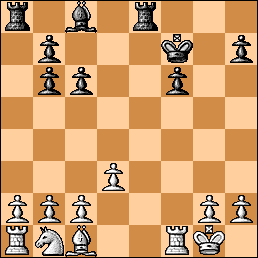
analysis diagram


In the game, Black gives up his Queen, and then his King.

12.Bg5+ Ke6 13.Bxd8 d4 14.Qd5 checkmate

Wednesday, May 18, 2011

Tap-Dancing on Ice


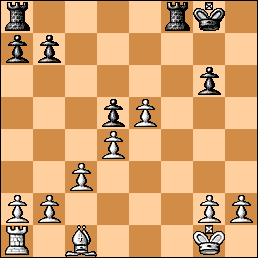
My latest Jerome Gambit was a slippery affair, a lot like tap-dancing on ice, for both me and my opponent. We each had our share of falls on the way to an interesting endgame. Finally, we reached the following position.


perrypawnpusher -BEEB
blitz, FICS, 2011


Despite White's outside, connected passed pawns, the best he can hope for is a complicated Queen-plus-pawns-versus-Queen-plus-pawns-ending which is most likely a draw at blitz speed, because soon (after ...Qxa2) Black will have his own connected passed pawns to run down the board. There will be too many chances to check the opposing King almost endlessly. The ticking clock will dictate safety.

35. Qf5+

This move does no harm, but as long as Black's King retreats to b6 it doesn't do much good, either.

Here is how the game could have continued, instead: 35.h4 Qxa2 36.Kh2 a5 (the race is on!) 37.h5 Qb2 38.Qg5+ (necessary to allow the White Queen to catch up with the h-pawn, otherwise, if 38.h6 then Black can rein in the runner: 38...Qe5+ 39.Qg3 Qh5+ 40.Qh3 Qe5+ 41.g3 a4 42.h7 Qh8 43.e5 a3 44.Qd7+ Kb6 45.exd6 a2 46.Qxc7+ Ka6 47.Qc4+ Kb6 48.Qxa2 Qxh7+ 49.Kg2 Qxd3 and a win, if there is one, is still a long way off) 38...Kc6 39.Qxa5 b5 40.d4 Kb7 (40...Qxd4 41.Qa6+ Kd7 42.Qxb5+ Ke7 43.Qg5+ and the White Queen is back on escort duty, although it is still complex) 41.h6 Qe2 42.Qc3 Qh5+ 43.Qh3 Qxh3+ 44.gxh3 b4 45.e5 (45.h7 b3 46.h8=Q b2 47.Qh7 b1=Q starting over again) 45...b3 46.e6 b2 47.e7 b1=Q 48.e8=Q and maybe there is a win, maybe there isn't...

35...Qe5

Oh, no.

A time-slip.

In the transition from middle game to endgame I had been checking Black's King, and perhaps my opponent figured that I would continue to do so, harmlessly, e.g. 36.Qd7+ Kb6.

But there is something better, and it can be seen, it doesn't have to be calculated.

36.Qxe5+ dxe5 37.h4 Kc6


Unfortunately, the King cannot enter the "square of the pawn". (Draw a diagonal from the pawn to the 8th rank. Black, to move, must be able to get inside that square in order to catch the pawn. He is one tempo short.)

38.h5 Kd6 39.h6 Ke7 40.h7


Black resigned

Tuesday, May 17, 2011

Checking Back

When I reported on the game AreWeThereYet - metheny, blitz, FICS, 2009 (0-1, 28) in "Watch that last step...", taking a look at the nameless opening line 1.e4 e5 2.Nf3 Nc6 3.Bc4 Na5  (which immediately got a Jerome Gambit-style twist, 4.Bxf7+ Kxf7 5.Nxe5+) I neglected to mention that the two played again four days later, with the outcome quickly reversed: AreWeThereYet - metheny, blitz, FICS, 20095...Ke8 6.Qh5+ Ke7 7.Qf7+ Kd6 8.d4 Qe7 9.Qd5 checkmate.

Time to check back and see how the opening is faring.

soulman  - Tadziu
standard, FICS, 2011

1.e4 e5 2.Bc4 Nc6 3.Nf3 Na5


4.Bxf7+

This move is not necessary; White can play the stronger (but much less fun) 4.Nxe5 instead.

4...Kxf7 5.Nxe5+ Ke8 6.Qh5+ Ke7
 
 
If you do a position search in The Database (using ChessBase1.e4 e5 2.Nf3 Nc6 3.Bc4 Nh5 4.Bxf7+ Kxf7 5.Nxe5+ Ke7 6.Qh5 and 5...Ke8 6.Qh5+ Ke7 continuations note that in the first case it is Black to move, in the second case, White.

7.Qf7+

Do a position search now, though, and the data return is clear, at least from one perspective: 55 games, White scores 71%.

7...Kd6 8.Qd5+

This is a good move, and in the majority of games White played it.

Only eleven games (1/5) had the best move for White, 8.d4. As only three games had Black playing the strongest reply to that move, 8...Qf6 (and Black won two of them), it is best to go over the reason that White should remember 8.d4.

After 8.d4 White threatens the devastating 9.Bf4, and Black's "best" is 9...Qf6, which falls to the inventive (and as yet unplayed) two-piece sacrifice, 10.Nc4+ Nxc4 11.Bf4+ Qxf4 12.Qxf4+ winning Black's Queen. (White can even interpolate 12.e5+ and wind up winning another piece.)

If Black defends against 8.d4 with 8...Nh6, instead, he immediately regrets that his Knight cannot go to f6 after 9.Qd5+ Ke7 10.Bg5+, winning the Queen. No better is 8...Ne7, as after 9.Qh5 White threatens Ne5-f7+, winning the Black Queen and Black wishes the Knight were on h6...

8...Ke7 9.d4

Clearly soulman has everything under control.

9...Nc6
 
Saving the wayward Knight that got this whole adventure started.
 
10.Bg5+

But losing the King after 10...Nf6 11.Qf7+ Kd6 12.Nc4 checkmate.

Black resigned

Monday, May 16, 2011

Peaceful, Not Frenetic

I have been trying for peaceful, not frenetic, Jerome Gambit games, slowly and steadily progressing toward victory. The following game is a good model for me. White gathers "small advantages" and calmly moves toward victory. But then...

Petasluk - krausepeter
blitz, FICS, 2011

1.e4 e5 2.Nf3 Nc6 3.Bc4 Bc5 4.Bxf7+


4...Kxf7 5.Nxe5+ Nxe5 6.Qh5+ Ke6


7.f4 g6

Black mixes up defensive systems -- or something. The Database shows 9 wins for White against 0 losses prior to this game. 7...Qf6 or 6...d6 would have been fine for Black.

8.Qxe5+

Here Black resigned in Petasluk - Meshu, FICS. 2011, played about a week earlier.

Superpippo has played, and gotten away with 8.f5+ in Superpippo-vacaboja, FICS, 2002 (1-0, 37) and 8.Qh3+ in Superpippo-ustad, FICS, 2002 (1-0, 34), but those moves are not to be recommended.

8...Kf7 9.Qd5+


There are nudges and then there are nudges... Actually, 9.Qxh8 was a little better, as in Ghandybh-duboak, Chess.com, 2009 (1-0, 16).


9.Qxc5 was also playable, as in grobnic - vallabhan, GameKnot.com, 2004 (1-0, 24).

9...Ke8 10.Qxc5 d6 11.Qd4 Nf6 12.0-0 Qe7


White is a comfortable two pawns up. There is no need for an immediate "bashi-bazouk attack", as calm development will do.

13.Nc3 Rf8 14.d3 c5 15.Qe3 Ng4


If anyone, Black could heed the advice not to attack prematurely.

16.Qf3 h5 17.h3 Ne5 18.Qg3 h4 19.Qe3 Nc6 20.Bd2 Be6 21.Rae1 Kd7

Both sides have developed, and Black's King has found some shelter, but the story remains the same: a comfortable advantage for White.

22.a3 Rg8 23.e5 d5

Black keeps the position closed, but now White has a protected passed pawn. For now the e-pawn is blockaded, but it remains another advantage to be realized in the future.

24.Qf2

Setting his eyes on the Black pawn at h4.

Instead, Rybka 3 recommended for White the involved pawn sacrifice on the Queenside, 24.Nb5 b6 25.c4 hoping to open attacking lines against Black's King.

It's not hard to side with Petasluk's choice. Besides, he is rated higher than his opponent, and might want to let him come up with the "brilliant" ideas.

24...Raf8 25.Nd1

Perhaps White was thinking of following this up with c2-c3 and d3-d4, erecting a center wall?

In any event, danger for him is brewing on the Kingside, and White needs to strike first, as Rybka 3 points out: 25.b4 g5 26.bxc5 gxf4 27.Rb1 Kc8 28.Nb5 Bxh3 29.Nd6+ Kb8 30.Rxb7+ Qxb7 31.Nxb7 Rxg2+ 32.Qxg2 Bxg2 33.Rb1 Bh3 34.Nd6+ Ka8 35.Nb5 a6 36.Nc7+ Ka7 37.Kh2 Bg4 38.Nxd5 Nxe5 39.Bxf4 Nf3+ 40.Kg2 Whew! That's a lot to figure out in a blitz game.

25...g5

This is what Black has been aiming for. Now White has to counter-punch and mix it up; there is no more "peaceful".

26.c4 gxf4 27.Bxf4 Bxh3 28.e6+ Kd8


29.Ne3 Bxg2 30.Nxd5

In the smoke of the battle, White goes astray. Clearly time was short for him, and attacking the enemy Queen is in general a good strategy, but here there was a discovered check to deal with. 

Rybka 3's suggestion lets the air out of the position, almost like each army consuming the other, with a draw as the result: 30.Nxg2 h3 31.Qe3 hxg2 32.Rf2 Qh7 33.Rxg2 Rxg2+ 34.Kxg2 dxc4 35.dxc4 Ke8 36.Bg3 Qc2+ 37.Qe2 Qxe2+ 38.Rxe2 Rg8 39.Kh3 Nd4 40.Re4 Rg6 41.e7 Nf3 42.Bf4 Ng5+ 43.Bxg5 Rxg5.

Both White's steady peaceful build-up and Black's savagery in counter-attacking would thus have been "rewarded".30...Bxd5+ 31.Kh2 Rg2+ 32.Qxg2 Bxg2 33.Kxg2 Rg8+ 34.Kh3 Nd4 35.Be3 Ke8

Here White forfeited on time.

Sunday, May 15, 2011

LPDO Revisited

In "My House! My House! My Kingdom for a House!" I mentioned Grandmaster John Nunn's acronym, LPDO, as a reminder that "Loose Pieces Drop Off". In the following game, Jerome Gambit Gemeinde member HauntedKnight takes that notion into account when planning his play, and it helps him grab a "loose" Knight. Black's resignation, only a pawn down, might be a bit early, but it is easily understood.

HauntedKnight - OneNoTrump
blitz, FICS, 2011

1.e4 e5 2.Nf3 Nc6 3.Bc4 Bc5 4.Bxf7+


4...Kxf7 5.Nxe5+ Nxe5 6.d4 Bb4+


Computers tend to like this move, for their own computer-ish reasons. For examples, see "Jerome Gambit: Drilling Down (1)" for RevvedUp's 2008 tag-team match against Hiarcs 8, Shredder 8, Yace Paderborn, Crafty 19.19 and Fritz 8, where this move showed up, played by Crafty. It also appears in Jeroen's earlier 2003 Jerome Gambit computer tournament in the game Deep Sjeng 1.5 - Hiarcs 9.

If the computers are given enough time they often find the recommended 6...Qh4!? as well.

Has OneNoTrump examined the Jerome Gambit with a computer, or is this a knee-jerk reaction (my Bishop is attacked, move it and attack White)?

7.c3 Bxc3+

A clue: this looks like a human decision. The 75 games that have this move in The Database all have a person playing Black.

Computers realize, of course, that Black must return a piece, and suggest something like 7...Ng6/c6 8.cxb4 to mess up White's pawns a bit; or they let White choose which piece he wants by playing 7...Qh4

8.bxc3


Bolstering White's center, but 8.Nxc3 was probably a bit better: development and all that.

8...Nc4 9.Qh5+ g6

Reflex. 

Better was 9...Kf8 and Black keeps his edge, even against 10.Qc5+ Nd6 11.e5, because he has 11...b6 12.Qb4 Qe7 when after 13.0-0 the Knight escapes with 13...Nf7

10.Qd5+ Black resigned


The loose piece at c4 will drop.

Saturday, May 14, 2011

My House! My House! My Kingdom for a House!

Passing the following game along to me with the note "Another Jerome Gambit swindle," Bill Wall explained the crux of the game in one sentence, and the psychology of the contest in another: My opponent tried to castle by hand, but dropped a rook. Opponents seem to panic when their king is in the center.

Wall,B - Yunfan
chess.com, 2011

1.e4 e5 2.Nf3 Nc6 3.Bc4 Bc5 4.Bxf7+


4...Kxf7 5.Nxe5+ Nxe5 6.Qh5+ Ng6


7.Qd5+ Ke8 8.Qxc5 d6 9.Qb5+


This is something new: in almost 24,000 games in The Database, this position does not show up at all!

The closest thing to it seems to be a 2006 FICS game, PierreKurdy - NLockwood (0-1, 58), which began: 1.e4 e5 2.Nf3 Nc6 3.Bc4 Bc5 4.Bxf7+ Kxf7 5.Nxe5+ Nxe5 6.Qh5+ Ng6 7.Qxc5 d6 8.Qd5+ Ke8 9.d3 Nf6 10.Qb5+ c6 11.Qb3. Of course, if you do a search on that position at move 11, you find that Bill Wall - Seven11, Chess.com, 2008 got there, too.

Giving "Jerome Gambit odds" requires alert, strong play. Familiarity with basic stratagems (Bill has studied The Database) is very useful.

So is the proper use of psychology. Here White asks (just like he does when his Queen checks from d5 in analogous situations) Black: is it worth the b-pawn to block the check with the Bishop? The answer is: probably not, but arriving at that conclusion takes time, as, Black reasons, surely, there must be some way to punish that impertinent Queen...

9...c6 10.Qb3

Posing the questions, Where will Black's Bishop go?, Where will Black's King go? and How will he get there?

10...Nf6 11.d3 Qa5+


12.Nc3 Rb8

You would almost expect Black to try something like 12...Qh5, but he is still worried about the White Queen at b3 and its attack on the pawn at b7.

The Rook move should give White some ideas based on GM John Nunn's warning: "LPDO, Loose Pieces Drop Off."

13.Bd2 Qb6

Another "solution" to the b7 pawn problem. That's three by my count: 9...c6, 12...Rb8 and now 13...Qb6.

It's all very reasonable, and the computer still gives Black the edge, but it is an indication that Black is uncomfortable with his position (instead of cheering himself: More than a dozen moves and I'm still better!)

14.Qa3 Ke7 15.f4 Re8


Having shored up Pb7, Black now goes about castling-by-hand to safeguard his King. That will make him feel a whole lot better. Multi-tasking will take its toll, though.

16.0-0-0 Kf8 17.Qxd6+ Kg8 18.Qxb8 Black resigned


Black can win the exchange with 18...Bg4, but that would leave him still three pawns down.

Friday, May 13, 2011

A Bit Unusual, Again

Black's 6th move in the following Jerome Gambit is a bit unusual, but it has been covered on this blog: see "Wait 'Till Next Year!", "A couple of pawns among friends..." and "Jerome Gambit and The Perfesser (Part I)".

UNPREDICTABLE - Kjosavik
blitz, FICS, 2011

1.e4 e5 2.Nf3 Nc6 3.Bc4 Bc5 4.Bxf7+


4...Kxf7 5.Nxe5+ Nxe5 6.Qh5+ Kf6


Not well thought out.

Before this game, The Database had 25 examples of this move, with White scoring 76%. (In 4 of the 6 White losses, understandably, the first player had overlooked White's next move.)

7.Qf5+ Ke7

The game has reached the same position as yesterday's. See "Alarming".

8.Qxe5+ Kf7 9.Qxc5

Simply capturing the Bishop, instead of playing around with 9.Qd5+ as in perrypawnpusher - Navarrra, blitz, FICS, 2011, (1-0, 26).

9...d6 10.Qe3 Nf6

White is a solid two pawns up.

11.d3 Re8 12.0-0 d5 13.f3 dxe4 14.fxe4 c6


15.e5

Somewhat impatient, although it is clear what is going on: White wants to use the pin on Black's Knight to win it with the pawn, although he temporarily overlooks the fact that the pawn, itself, is pinned by the Black Rook.

Ever-so-patiently Rybka suggests that White complete his development first: 15.Qc5 Qb6 16.Qxb6 axb6 17.b3 b5 18.Bb2 Kg6 19.a3 Bd7 20.Nd2 h6 21.Rf3 Be6 22.Raf1.


analysis diagram


This is not an "exciting" position, but White can safely look forward to making his extra material count.

15...Qb6

Overlooking the pin on the Knight. Rybka suggests that Black break the pin with 15...Kg8, but then recommends an exchange sacrifice for White: 16.d4 Nd5 17.Qe4 g6 18.Nc3 Bf5 19.Rxf5 gxf5 leading to and endgame where White's Bishop plus three pawns outrank Black's Rook, 20.Qxf5 Qb6 21.Nxd5 cxd5 22.c3 Rf8 23.Qg5+ Qg6 24.Qxg6+ hxg6.


analysis diagram


If only chess were as easy as Rybka makes it seem!

(No doubt Rybka would mutter, if it could: Humans don't win with the Jerome Gambit, they lose against it! There is a difference!)

16.Qxb6 axb6 17.exf6 gxf6


18.Nc3 Be6 19.Ne4 f5 20.Nd6+ Black resigned